In the context of rapid urbanization in Vietnam, especially in major cities like Ho Chi Minh City, flooding after tropical rain showers has become a nightmare for many homeowners. However, instead of trying to dispose of rainwater into the already overloaded public drainage system, why not turn it into a valuable resource for your own garden? A rain garden is not just an aesthetically pleasing landscape feature with vibrant flowers and plants, but also an intelligent "biological filtration system." At Caydecor, we believe that designing rain gardens is a pioneering step in realizing the philosophy of "Living with the Ecosystem," where every drop of water that falls is cherished to nourish Mother Earth.
1. What is a rain garden and why do urban villas need one?
A rain garden is a strategically designed depression in the landscape that utilizes specialized permeable soil layers and native vegetation to collect and treat rainwater runoff from rooftops, driveways, or patios. Instead of putting pressure on urban infrastructure, rain gardens allow the water to gradually seep into groundwater within 12-24 hours, naturally removing pollutants.
See more: What is Sponge Landscape? Explanation and details.
1.1. Physicochemical and biological filtration mechanisms through soil layers (Phytoremediation & CEC)
The mechanism of a successful rain garden relies on a complex interplay of physical, chemical, and biological processes occurring in the root zone. As rainwater runoff from urban surfaces, it carries away impurities such as fine dust, heavy metals (lead, copper, zinc), hydrocarbons from vehicles, and fertilizer residues (nitrogen, phosphorus).
First, physical filtration occurs in the mulch layer and soil surface, where suspended particles are trapped. However, the heart of the system is the index. CEC (Cation Exchange Capacity) of the soil. The soil in Caydecor's rain garden is designed with a high content of clay and humus, creating negative electrical charges on the surface of the soil particles. These charges attract and hold onto positively charged heavy metals, preventing them from penetrating deep into the groundwater.
Next is the process PhytoremediationPlant treatment)The root system of flood-tolerant plant species such as sea buckthorn (Hymenocallis littoralisThe soil not only absorbs water but also "draws in" excess nutrients such as nitrogen and phosphorus to support its growth. At the same time, the rhizosphere is home to billions of aerobic bacteria. They secrete specific enzymes to break down complex hydrocarbon molecules into harmless compounds. This is the clearest manifestation of "soil nourishment"—creating conditions for microorganisms to work and sustain life.
1.2. Plant Selection: The Art of Adapting to Harsh Conditions
Plants in rain gardens face a double challenge: localized flooding during the rainy season and prolonged drought during the dry season. In Southern Vietnam, we prioritize native species with deep root systems and good resilience.
- Upper floors: Barringtonia tree (Slamanea saman) Or, Melaleuca alternifolia has good water resistance.
- Lower floor: Water bambooCyperus alternifolius), forest lilies, or river lilies. These species not only perform well in water filtration but also create a cool, aesthetically pleasing green space for the villa.
1.3. Structure of the natural drainage layer (Bio-swale) and hydrological calculations
To prevent a rain garden from turning into a "mud pit" or a mosquito breeding ground, the engineering structure of the Bio-swale (biological ditch) system must be meticulously calculated. A standard structure at Caydecor includes four core layers:
- Surface padding layer (Pond area): The depth is typically 15-20cm, calculated based on the catchment area (roofs, yards) to ensure sufficient collection of the maximum amount of rainwater in 2 hours.
- Planting Soil Mix: This is the most important component, usually consisting of 50% construction sand, 20-30% organic humus soil, and 20% clean loam soil. This ratio ensures an infiltration rate of 2.5 to 5 cm per hour, sufficient to prevent water from stagnating for too long and causing root rot.
- Transition Layer: A 5cm thick layer of fine sand is used to prevent soil particles from the upper layers from washing down and clogging the rock below.
- Storage and Drainage Layer: It consists of pebbles or gravel measuring 2-4 cm. This layer creates large void spaces that temporarily hold water before it completely seeps into the natural soil.
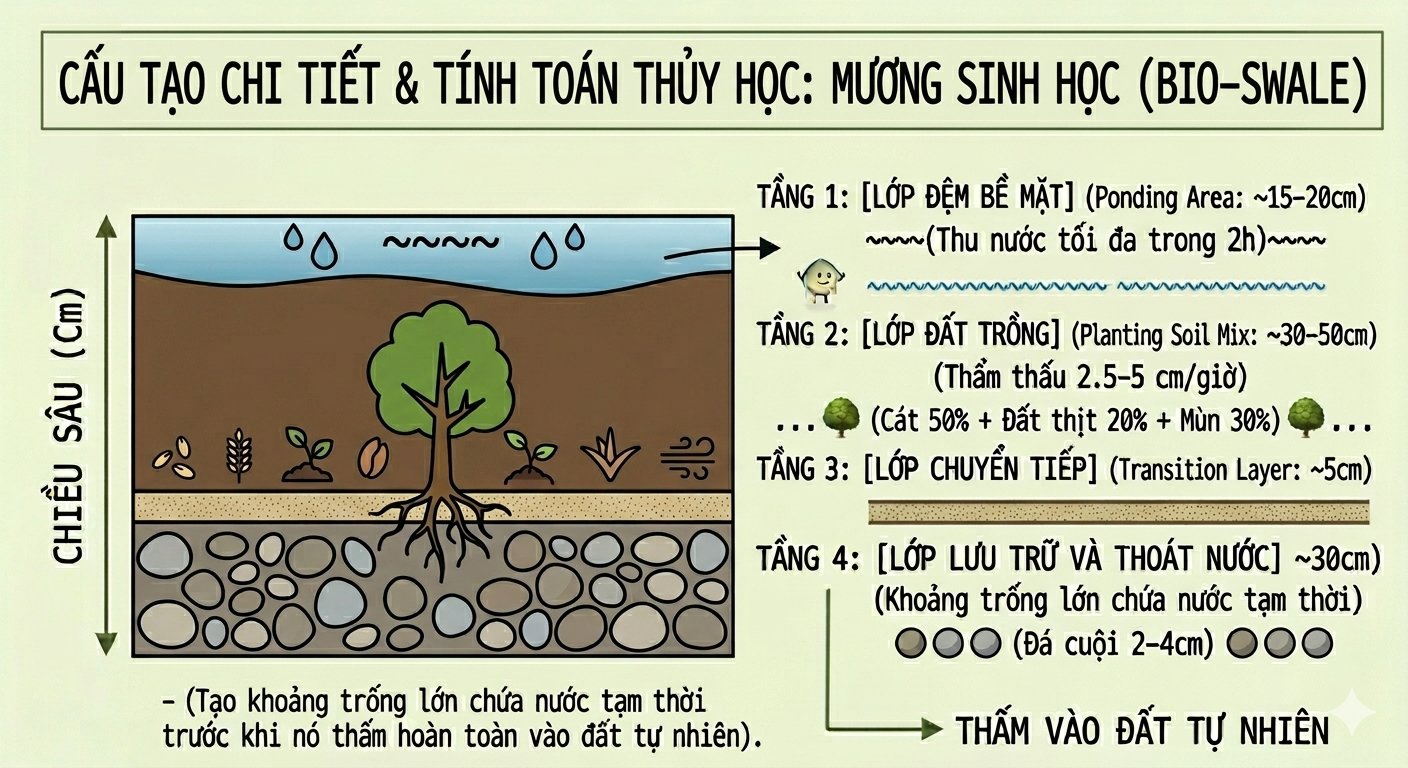
Installing an overflow pipe positioned 15cm above ground level is necessary to handle unusually heavy rainfall, ensuring the structural safety of the building. This process is not merely a construction technique but also reflects an understanding of the flow of natural energy, helping to maintain ideal humidity levels to nurture the microbial ecosystem, a core principle. "Earth cultivation" which Caydecor pursues in its projects Purely organic landscape.
2. Benefits of rain gardens
| interest groups | Specific details | Value delivered |
| Water management | Absorbs and retains rainwater runoff from roofs and yards. | Preventing localized flooding and reducing the burden on urban drainage systems. |
| Natural purification | The soil layers and plant roots act as biological filters. | Remove dirt, heavy metals, and chemicals before allowing the solution to seep into the groundwater. |
| Biodiversity | Create habitats for birds, butterflies, and natural predators. | It balances the ecosystem, helping to control pests naturally without the need for chemicals. |
| Save resources | Soil rich in organic matter helps retain moisture for longer. | Significantly reduces irrigation water usage and the need for routine maintenance. |
| Health & Beauty | Create a cool, safe, and chemical-free green space. | Enhance the natural beauty of your home while ensuring the safety of your family and pets. |
Why should rain gardens be incorporated into organic design?
The construction of rain gardens is not just for decorative purposes, but also represents a commitment to the environment:
- Regenerating groundwater: Instead of letting the water flow away, you are "returning" it to the earth.
- Low cost – High efficiency: Rain gardens utilize the terrain and native plants, so they are often cheaper to construct than complex mechanical filtration systems.
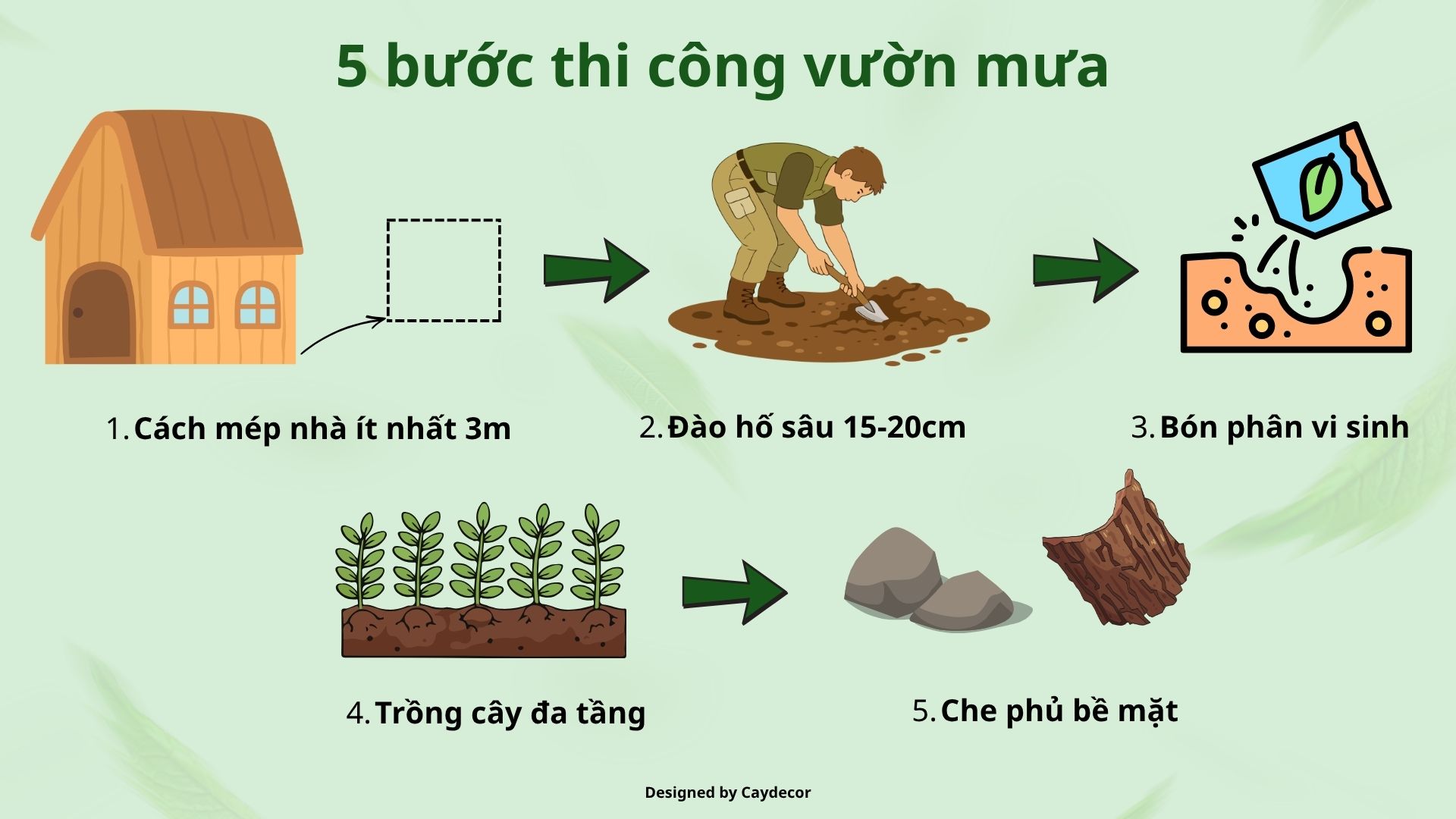
3. The 5-step process for constructing a standard organic rain garden.
- Determine the location: Keep a distance of at least 3 meters from the foundation to prevent water from seeping back into the structure.
- Dig the hole and shape it: The depth is usually between 15-25cm, depending on the water collection volume.
- Soil improvement: Implement a process for restoring degraded soil using compost and microorganisms.
- Planting trees in multiple layers: Arrange the plants according to their water tolerance, from the center of the garden to the edges.
- Surface covering (Mulching): Use pebbles or bark to prevent erosion when heavy rains fall in the garden.
4. Difficulties in creating a rain garden
Although rain gardens offer many ecological benefits, their design and construction also present certain challenges. Below are some common difficulties you may encounter:
4.1. Calculation and location selection techniques
- Determine the slope and elevation: Rain gardens should be located below the level of water runoff (such as on rooftops or walkways) but not too close to the building's foundation (usually at least 3 meters away) to avoid causing mold growth on the structure.
- Calculate the area: If the garden is too small for the amount of water that can run off, it will overflow and become waterlogged; if it is too large, the plants may dry out during the dry season.
- Check the soil permeability: Soil that is too clayey will cause water to stagnate for too long (attracting mosquitoes), while soil that is too sandy will absorb water too quickly, not giving plant roots enough time to filter out toxins.
4.2. Choosing the right crop
- Extreme tolerance: You need to find "versatile" plants – those that can both tolerate temporary waterlogging during heavy rains and thrive in dry conditions during intense sunlight.
- Prioritize native plant species: Finding and combining native plants with deep root systems to effectively filter water can sometimes be more difficult than with common ornamental plants sold in nurseries.
4.3. Initial maintenance work
- Weed removal: In the first 1-2 years, before the crops have fully covered the land, weeds can easily invade due to the moist and nutrient-rich soil environment.
- Erosion: If the water flow into the garden is too strong without layers of gravel or energy-dissipating material at the receiving point, the soil and seedlings are easily washed away.
4.4. Hygiene and insect problems
- Risk of water accumulation: If gardens are not designed to drain completely within 24-48 hours, they can become breeding grounds for mosquitoes and other harmful insects.
- Waste accumulation: Rainwater often carries debris, dry leaves, and mud. If not cleaned up regularly, these layers of fine mud will clog the pores in the soil, reducing the garden's ability to absorb water.
| Hard | Solutions |
| Poorly permeable soil | Replace some of the soil with a mixture of sand, loam, and gravel. |
| Trees die due to waterlogging/drought. | Choose native plants with deep root systems and high adaptability. |
| Mosquitoes are breeding. | The substrate is designed for good drainage, ensuring that all water is absorbed within a maximum of 48 hours. |
| Surface erosion | Use large stones or gravel at the point where water flows into the garden. |
See more: Guide to proper landscape care and maintenance.
To overcome technical challenges, carefully calculating soil permeability and selecting the right "versatile" plant species (tolerant of both waterlogging and drought) are crucial factors for the success of your garden.